Looking for Strategic Advantage? Apply Early
When I meet with junior families to deliver preliminary college lists, we start with a discussion of the latest admissions trends and how they will shape our strategic plan for the next application cycle. The first trend on this year’s list (again): The Early Admissions Advantage.
Let’s start with the data, courtesy of the Common App December 1st Deadline Update, where we clearly see the trend towards applying early began after the pandemic, and continues its upward rise this year.
More Early Applicants: Compared to last year, we see a 4% increase in first year applicants filing at least one application by December 1st. To give you a sense of how much this trend has grown - this year’s early applicant group represents a 30% jump compared to the 2021-2022 cycle.
Applying Early to More Schools: On average, early applicants applied to 5.38 colleges this year, a 5% increase from a year ago - and a 14% increase from 2021-2022.
Means Skyrocketing Application Volume: Early application volume experienced robust year-to-year growth at 9%. Compared to 2021-2022 that's a more than 51% jump in the number of early applications filed.
With more applicants applying early, and a rise in deferrals, what is the advantage of applying early?
Admit rates tend to be higher. This doesn’t necessarily mean every student has a higher chance of admission in the early action rounds, all things being equal - as many colleges claim that early applicants are stronger. But earlier applications do signal strong interest and can stand a better chance for admission to limited seat/restricted majors where space is tightly limited.
Merit aid is limited and eventually runs out, so earlier consideration is key. Not everyone shares them specifically, but look for scholarship deadlines or “priority” deadlines and get ahead of those.
Application submission dates often trigger housing priority, a key benefit when housing is in high demand or not guaranteed for first year students.
Honors College, Fellowships, and other special programs often have earlier deadlines and select from the early applicant pool.
Is it always advantageous to apply early? No. Like just about everything in college admissions, it depends.
Make an honest assessment of how your candidacy stacks up against the admitted student profile for each college on your list - including holistic factors for those that admit holistically. (Or - ask me and I’ll tell you.) If you are at or above the 50th percentile, and particularly if you are hovering near/above the 75th (the optimal “merit zone”), then, generally speaking, applying early is a good idea. But if not, it could be to your advantage to use the fall semester to improve your test scores and build strong first semester grades to bolster your application before you submit. (I can advise you on this, too.)
What about Early Decision?
Applying under a binding early decision agreement is one way to clearly signal strong demonstrated interest, as you are committing to withdrawing all other applications and submitting your enrollment deposit if you are admitted. (Please remember to read the fine print, as Early Decision Agreements can vary quite a bit on the timing of these requirements and whether you have the right to see your full financial aid offer prior to eliminating every other college on your list.)
For many schools, ED admit rates are higher than regular decision admit rates. For some colleges, Early Decision is the pool from which a majority of the first year class is created. For example:
A sampling of colleges with >90% ED admit rates: University of Vermont (94% for the first year class entering Fall 2024), Drexel University (92% Fall 2024), and Elon University (92% Fall 2024).
A sampling of colleges with two-thirds or more of their first year class admitted from the Early Decision rounds: Davidson College (66% for the first year class entering Fall 2024), Emory University/Oxford College (68% Fall 2024), and Tulane University (65% Fall 2025).
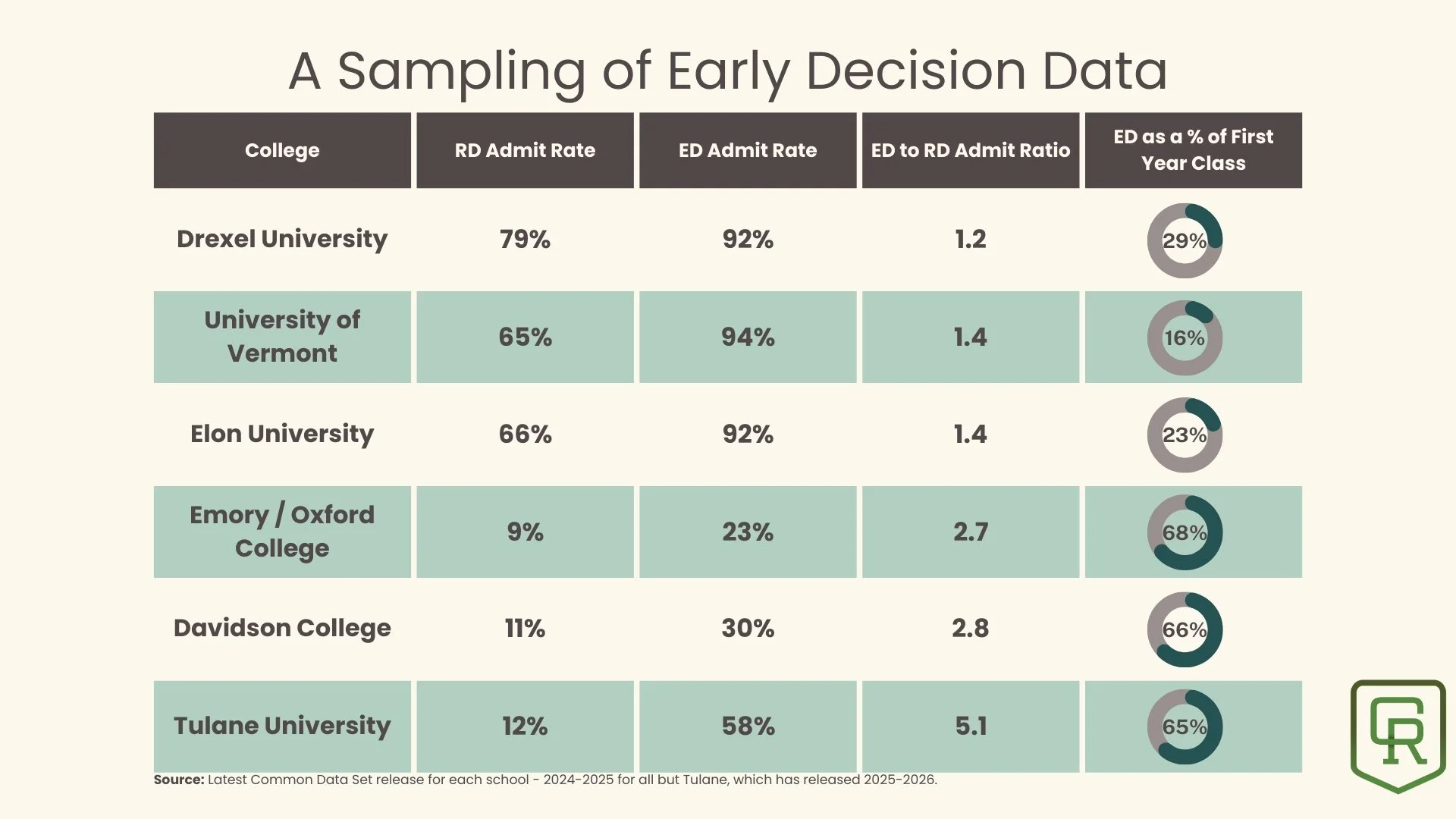
Source: Most recent Common Data Set (CDS) for each institution (linked in text above) - 2024-2025 for all but Tulane, which has released its 2025-2026 CDS.
Colleges rarely, if ever, provide admitted profiles separately for the binding Early Decision admits versus Early Action/Regular Decision admits. But to the extent that Early Decision helps them shape their incoming class with the confidence that each admitted student will enroll, it stands to reason that the early binding commitment minimally provides bonus points to your application. In some cases, the boost is much bigger. Either way, it that does not mean the admissions standards are significantly different, as many popular colleges have far more highly qualified applicants than spots.
Applying ED should not be taken lightly. Of course, a bump in admissions does not necessarily mean it’s the best plan for everyone. I see tremendous development and shifts in students’ top college choices as they visit more schools and dive deeper into their major/career path and college research. The downside of applying ED is that the early commitment takes all other options off the table - so everyone involved needs to be certain they’ve done thorough research and have no doubt it is the best path forward.
The trend towards early applications, and the benefits to earlier admission are a well-founded, strong reason to develop a balanced college list by the end of junior year. Does your junior have a great fit, affordable, and balanced college list?
If not, I invite you to schedule a Discovery Session to learn how to put college expertise and consultative coaching to work for your family.